
Bharti Airtel may end up cumulatively bidding for more spectrum than market leader Reliance Jio in the upcoming auctions. This is owing to its need for spectrum renewal, and a requirement for 900 MHz in a few circles, analysts have said. Despite the muted bidding expected in the upcoming auctions, Airtel may end up making more bids than Jio, they added.

Bharti Airtel, Reliance Jio, Vodafone Idea said the Railways should not be permitted to offer commercial services like Wi-fi and voice and video communication.

Kumar Mangalam Birla will be the non-executive chairman and Balesh Sharma the new CEO of the merged entity, which will remain listed.

Vodafone Idea's (Vi's) search for a lifeline has turned longer and tougher even as it continues to lose customers and delay vendor payments. Vi's much-needed Rs 1,600-crore fundraising plan got stuck due to the government's silence on picking up a proposed 33 per cent equity in the financially stressed telco. The development spells further trouble for the company, which has an overall debt pile of Rs 2.2 trillion, including hefty dues to the government.

Domestic quarterly earnings, global trends and foreign fund trading activity would dictate the movement in equity markets, which may face volatility amid the scheduled monthly derivatives expiry this week, analysts said. Equity markets took a breather last week. The BSE Sensex declined 298.22 points or 0.48 per cent and the Nifty dipped 111.4 points or 0.60 per cent.
This is the biggest equity-raising exercise by an Indian corporate within a financial year. The fundraising - led by Citibank, Goldman, Kotak and Axis Capital as bankers - will see participation by foreign and domestic institutional investors.

Over the past one-and-half years, the number of stocks trading below their respective face value has increased 29 per cent after a sharp correction in stocks of small-cap companies.
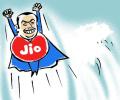
Reliance Jio's aggressive target to reach 100 million households through the launch of the 5G fixed wireless access (FWA) could make it one of the world's largest players in this space. But this also marks a change from its earlier strategy of offering fibre-to-the home (FTTH) broadband to households. Despite its best efforts, in two years Jio has been able to connect only 7 million households with FTTH, as permission for right of way for the last mile became a major impediment and the process of laying ducts for the roll-out was slow and cumbersome.

The government is likely to get about Rs 24,000 crore from one-time spectrum fee that has been levied on existing operators for holding radiowaves beyond a prescribed limit.

Jio's adjusted gross revenue share went up by 7 percentage points in Q2FY18-19 over the previous quarter in the circles of the C category.
Reliance Jio has sent a second legal opinion to the Telecom Regulatory Authority of India (Trai) on the subject of the potential allocation of satellite spectrum. The letter is written by retired Supreme Court Justice L Nageshwara Rao and argues in favour of auctions, stating that any other method for allocating spectrum apart from auctions could be constitutionally unsound. Business Standard has reviewed the letter.

India's telecom sector has been through dizzying peaks, troughs, policy U-turns, court battles, brutal competition, and daily controversies. India could go back to a private sector duopoly with just Reliance Jio and Bharti Airtel surviving the mayhem. The third player, Vodafone Idea, could be history.

Service was launched in Mumbai in July and it will be expanded across the country in a phased manner

Vodafone and Bharti have pointed out that, for data, their revenue realisation should be at Rs 30-35 per GB for them to cover their costs as opposed to the current figure of over Rs 11 per GB. But Jio has suggested a gradual increase to Rs 15 per GB and then maybe to Rs 20 per GB after six to nine months.

Telecom operator Bharti Airtel on Monday announced 20-25 per cent tariff hikes for various prepaid offerings, including tariffed voice plans, unlimited voice bundles and data top-ups, and said the new rates will come into effect from November 26. The entry-level tariffed voice plan has been raised by about 25 per cent, while for unlimited voice bundles, the increase in most cases is about 20 per cent. Sunil Mittal led telco -- whose India mobile customer base stood at about 323 million at the last count -- has also increased the tariffs for data top-up plans by about 20-21 per cent

'We have informed the government multiple times that the situation in the US and India are different.' 'Here, there will be a 500 MHz gap in the frequencies which will safely allow aviation without interference.'

What stood out in his 15-year journey as a member of the political executive at the Centre was his glowing record as India's most successful and effective finance minister. Both as prime minister and finance minister, he understood the importance of gradualism, except when the economy or the polity was in a crisis.

Among other segments, home broadband subscriptions have picked up and the virtual private network service, too, increased by around 15 per cent.

RBI's exercise will take into account standards of governance, the viability of the payment bank (PB) business model, and changes, if any, if needed.

The move comes against the backdrop of the US and some of its allies banning the purchase of Chinese telecom gear over security concerns and pressuring other countries to follow suit.
Bharti Airtel called the prices exorbitant while Vodafone Idea wants the auctions take place in 2020. The auctions need to happen when the infrastructure is ready for the roll out, be it in terms of fiberisation levels, or optimisation of equipment and software etc. Spending a hefty amount on a technology (airwaves) that at present offers limited returns is not going to be a priority for the incumbent telcos.

Ajit Mishra, vice president, research, Religare Broking, answers your stockmarket queries.
With the Adanis submitting an earnest money deposit (EMD) of just Rs 100 crore on Monday for the upcoming 5G spectrum auction, the apprehension among the rivals that the group is nursing ambitions of being an all-India mobile player has been allayed at least for now. Based on its EMD, analysts say it can buy spectrum worth just Rs 900 crore, whose use will be limited to enterprises and captive networks -- that too is likely only in a few circles where it has its infrastructure like ports, airports, and power stations. While getting all-India millimetre band spectrum of 400 MHz (which costs Rs 2,800 crore) is ruled out, it might choose circles like Gujarat and Mumbai to start with.

Bindisha Sarang takes a look at Vodafone's RedX and Airtel's new plan.

Prime Minister Narendra Modi on Saturday inaugurated the 6th India Mobile Congress at Pragati Maidan in Delhi and launched 5G services. The 5G telecom services seek to provide seamless coverage, high data rate, low latency and highly reliable communications system. The three major telecom operators of the country demonstrated one use case each in front of the prime minister to show the potential of 5G technology in India.

The move will help telcos, including Reliance Jio, Vodafone, and Idea Cellular

Reliance-Google's new smartphone has got mixed reviews from analysts and brokerages. The phone pricing is seen unattractive for low-end customers and bundled offers are being viewed as non-disruptive. While this could slow the pace of adoption, it could set the stage for tariff hikes in the industry, feel analysts.
The Indian market is more in sync with mobile markets of advanced countries like the UK, Japan, and South Korea, where there are fewer players - three to four.


Bulk of these customers use 2G phones and are still focused on voice services and might prove useful for both Bharti Airtel and the Idea-Vodafone combine.

Telecom gear makers, who are in talks with telcos, say that if all goes well, they are ready to roll out the first phase of 5G services from October this year and cover the country's top 30-50 cities (in limited areas) by March 2023. The gear makers expect the telecom companies to give them a heads-up about their plans as well as the equipment required by July, and have promised deployment in three to four months after that. India's main telecom gear suppliers are Nokia, Ericsson and Samsung.

Ajit Mishra, vice president, research, Religare Broking, answers your stockmarket queries.
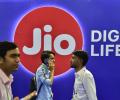
Mukesh Ambani-led Reliance Jio has introduced a 20-per cent cashback offer on select prepaid plans, intensifying competition in the Indian telecommunications (telecom) market. Jio is the largest telecom service provider in India, with 443 million subscribers as of July. Jio's cashback offer will drive cross-selling across Reliance's various retail businesses, but the move is also being seen by some analysts as a signal that tariff hikes may not be around the corner just yet.

Vodafone-Idea is working on a multi-pronged strategy to begin its long journey to get back in the game but much hinges on how much money it can raise following the government's decision to go for equity conversion last week. Based on discussions with sources aware of the company developments and with vendors, VIL's immediate plan is to invest in increasing 4G coverage to the level of its competitors. Currently, it covers a 1 billion population with 4G while its competitors cover 1.2 billion people.

The Department of Telecom may bar operators holding 3G airwaves from sharing the high-speed spectrum.

It came as a surprise to all stakeholders - competing telecom companies (telcos), most analysts and even the government's internal projections on revenues from the 5G auctions. Reliance Jio disrupted all calculations by paying a stiff Rs 40,000 crore to buy 10 MHz of spectrum in the 700-MHz band, globally considered a key band for efficient 5G service coverage, along with the default 3.5 GHz band and the ultra-high speed and low-latency millimetre band of 26 GHz band. So what made Jio pay almost 45 per cent of its total spend in this auction for the 700 MHz band - much more than what it rustled up even for the 3.5 GHz band?

Under another plan, it will offer unlimited voice calling along with 100 SMS per day, 5GB 3G/4G data and free subscription to Wynk Music and Wynk Movies for Rs 1,599

Ajit Mishra, vice president, Research, Religare Broking, answers your stock market queries.
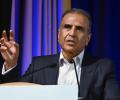
'If you are going to have only a handful of telecom players on whom the entire dream of Digital India rests, it's important they are financially sustainable.'

'Private banks are well-placed to deliver good performance over the next six months.'
 © 2026 Rediff.com - Advertise with us - Disclaimer - Privacy Policy - Sitemap - Feedback - About us - Terms of use - Grievances